US President Donald Trump remains unperturbed by China's recent military maneuvers near Taiwan, arguing that the activities are standard procedure. Addressing the media, Trump highlighted his close rapport with Chinese President Xi Jinping and noted that the military exercises were not discussed during their conversations. He referred to China's longstanding naval operations in the region, asserting there is no reason for alarm.
Shortly after the US made one of its most significant arms sales to Taiwan, China commenced a series of military exercises, which simulate blockades and the occupation of vital Taiwanese areas. Beijing presents these drills as a warning against Taiwan's independence efforts and foreign meddling.
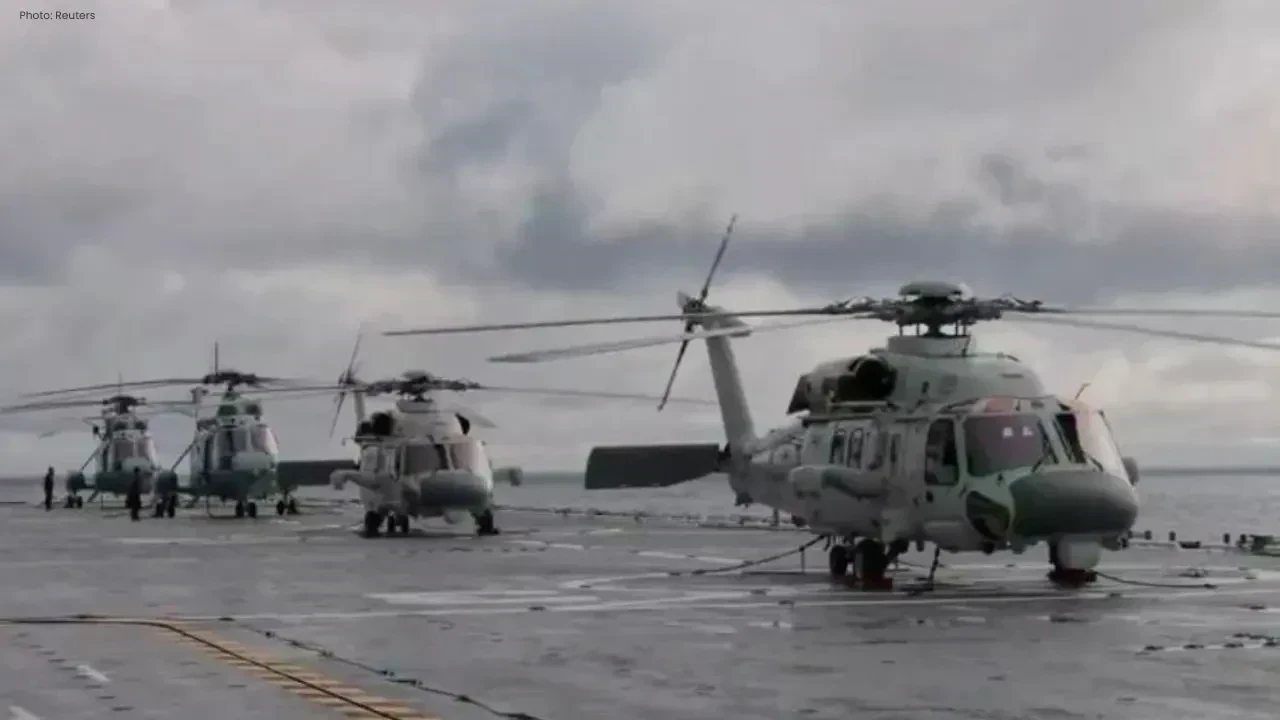
The Chinese military outlined plans for ten hours of live-fire drills across five maritime and aerial zones surrounding Taiwan. The Eastern Theater Command has deployed various vessels, including destroyers and fighters, to showcase synchronized air and sea operations.
Taiwan's defense ministry reported that 130 Chinese military planes were active in the vicinity, with 90 crossing the unofficial median line within their airspace—an area that China does not acknowledge. Additionally, numerous Chinese naval ships were detected near Taiwanese waters. Taiwan has responded by mobilizing its air force, naval assets, and missile systems to oversee and counter these drills.
Taiwan’s presidential office condemned these exercises as violations of international standards. President Lai Ching-te denounced the increasing military pressure as irresponsible, assuring that Taiwan would act with caution to protect its sovereignty.
Experts believe that the main target of these exercises is the United States, Japan, and former President Trump, expressing Beijing’s dissatisfaction over US arms transactions with Taiwan. These deals involve offensive weaponry capable of reaching the Chinese mainland, heightening tensions in the region.
Concerns have also arisen within the US regarding Trump’s potential transactional approach to Taiwan, which might undermine America’s commitment in favor of economic benefits.
While Trump perceives the drills as routine, experts warn that China's military modernization and increased operations around Taiwan signify a more assertive strategy. They caution that personal connections between Trump and Xi Jinping will likely have minimal influence on China's overarching goals.
China continues to pursue reunification with Taiwan and does not exclude the possibility of military action. Over recent years, it has intensified its military pressure, prompting Taiwan to enhance its defense capabilities. The US remains the primary arms provider to Taiwan, despite keeping formal diplomatic relations with Beijing.
In response to the arms sale, China has enacted sanctions against American defense firms and pledged to robustly counter what it deems provocations by Taiwanese independence supporters and US affiliations.
Chinese Foreign Minister Wang Yi underscored that the complete reunification with Taiwan is a pivotal goal that China is resolutely committed to achieving.