The Ministry of Defence in Thailand is ramping up its initiatives aimed at fortifying the nation's defence industry and military production capabilities, focusing on extensive research and development endeavors. A recent visit by senior defense officials to the Military Explosives Factory in Nakhon Sawan Province was conducted to evaluate production operations alongside ongoing tech advancements essential for enhancing the nation’s security independence.
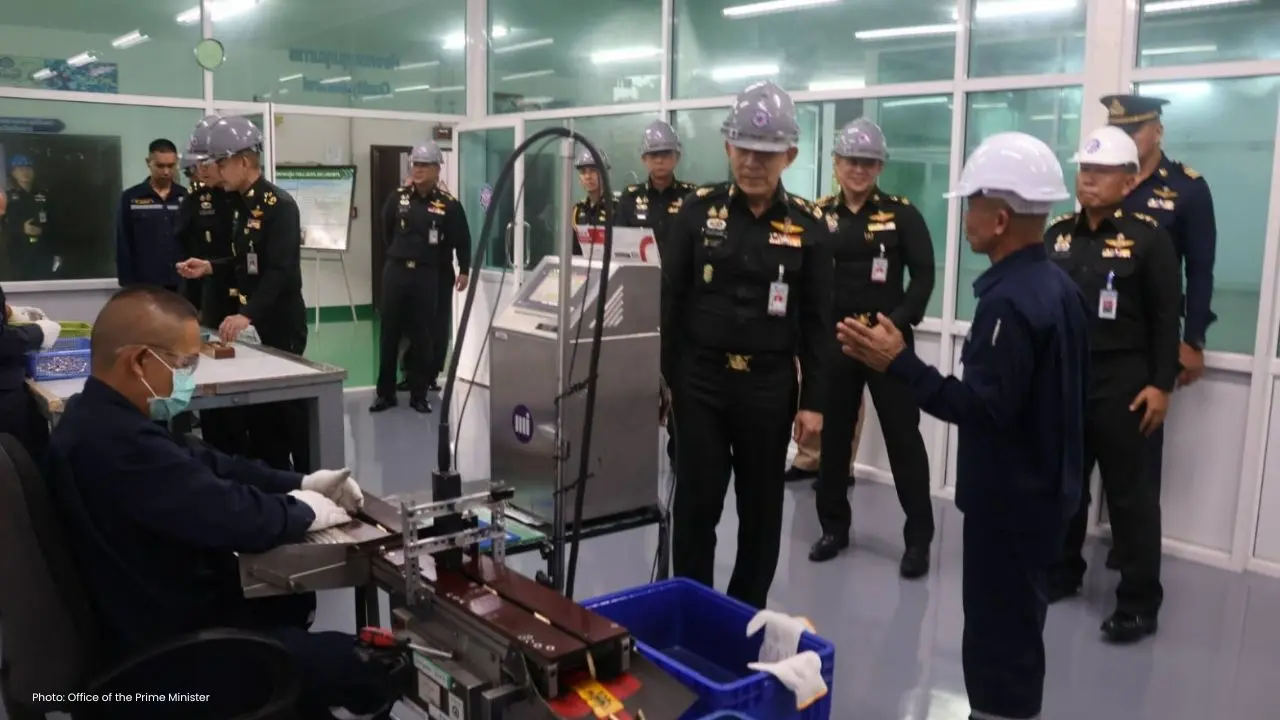
This evaluation occurred on May 15, 2026, under the leadership of General Tharaphong Malakham, Permanent Secretary of the Defence Ministry, accompanied by Deputy Permanent Secretary General Sarun Petranon and naval high-ranking officials. They explored the Military Explosives Factory located in Yan Matri Subdistrict, Phayuhakhiri District, which falls under the Department of Military Industry, Defence Industry, and Military Energy Center.
During their assessment, the officials delved into the factory's fundamental production undertakings, research pursuits, and prospective growth agendas. The Ministry of Defence highlighted that the chief aim is to enhance the nation’s defence manufacturing landscape by refining explosive and propellant production techniques to align with international benchmarks while curtailing dependency on external imports.
Serving a critical function, the Military Explosives Factory is responsible for producing ammunition, explosives, and military supplies for the Ministry of Defence, various government entities, and private sector customers, both domestically and abroad. The officials conveyed that the facility also engages proactively in research and product evolution to cater to the upcoming demands of the defence sector.
The Ministry asserts that the factory currently has the capacity to create single-base and twin-base tubular propellants that conform to United States and NATO standards. The annual output of the facility is approximately 372 tons, comprising 300 tons of single-base propellant and 72 tons of twin-base propellant, operational in three shifts daily to ensure optimal production efficacy.
Moreover, the facility is capable of manufacturing twin-base spherical propellant, employing technology acquired from China’s Norinco defence company, signifying a major stride in bolstering Thailand's domestic military manufacturing autonomy with an annual output nearing 70 tons.
During the assessment, General Tharaphong scrutinized the production workflow of spherical propellant pellets, the assembly processes of ammunition, and ongoing maintenance strategies for the factory. Updates concerning a collaborative research initiative with Kasetsart University, aimed at creating Thai cotton varieties for producing nitrocellulose—a pivotal material for military explosives—were also presented.
The government envisions this initiative as instrumental in lessening Thailand's dependence on imported resources while nurturing a more sustainable, self-reliant defence sector. Defence officials asserted that reinforcing local production capabilities is increasingly pivotal as global security dilemmas and geopolitical instabilities intensify.
Looking ahead, the Ministry of Defence emphasized that forthcoming investments in military research, advanced manufacturing solutions, and the cultivation of domestic raw materials will remain integral elements of Thailand’s overarching national security framework.