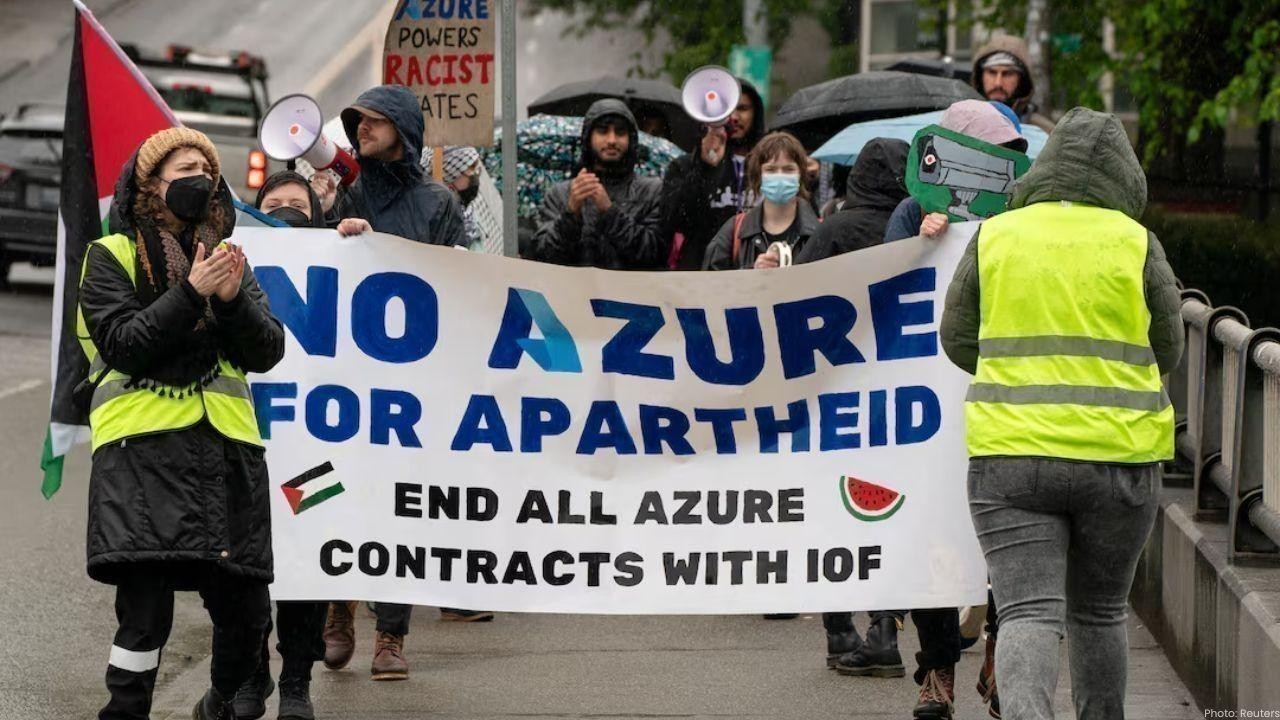
Microsoft, one of the world’s largest technology companies, has recently fired four of its employees who took part in protests at the company’s offices. These protests were focused on Microsoft’s connections with Israel, especially during the ongoing war in Gaza. The dismissed employees include Anna Hattle, Riki Fameli, Nisreen Jaradat, and Julius Shan.
Anna Hattle and Riki Fameli were the first to be informed about their termination. They received voicemails from Microsoft letting them know that they had lost their jobs. Both had participated in a sit-in at the office of Microsoft’s president, Brad Smith, earlier this week. A statement released by the protest group, No Azure for Apartheid, confirmed the news of their firing on Wednesday.
Stay informed with the latest news. Follow DXB News Network on WhatsApp Channel
Later, the group announced that two more employees, Nisreen Jaradat and Julius Shan, had also been fired. These employees had been part of protests that included setting up small encampments at Microsoft’s headquarters.
Microsoft stated that these terminations were the result of serious breaches of company policies. In its official statement on Thursday, the company said that the on-site demonstrations had caused “significant safety concerns.” Microsoft emphasized that maintaining a safe work environment was a priority, and that the actions of the employees violated the rules set for all workers.
No Azure for Apartheid, the protest group, has been vocal about its demands. The group, whose name is inspired by Microsoft’s cloud software Azure, has asked Microsoft to stop providing services to Israel. They have also demanded that Microsoft pay reparations to Palestinians affected by the ongoing conflict.
Anna Hattle explained the reason for the protest in a public statement. She said, “We are here because Microsoft continues to provide Israel with the tools it needs to commit genocide while gaslighting and misdirecting its own workers about this reality.” Her words reflect the frustration and anger of employees who believe the company’s technology is being used to harm civilians.
The protests escalated when seven individuals, including Hattle and Fameli, occupied the office of Microsoft President Brad Smith. This act of civil disobedience led to their arrest on Tuesday. Among those arrested, five were either former employees or people who were not directly connected to Microsoft.
Brad Smith, Microsoft’s president, responded to the incident by reaffirming the company’s respect for freedom of expression. He noted that while Microsoft values the right of everyone in the country to speak freely, such expression must be carried out lawfully.
The protests against Microsoft’s involvement with Israel gained more attention after a recent joint media investigation revealed that Israeli military agencies were using Microsoft’s Azure cloud services for surveillance. The investigation, conducted by The Guardian, +972 Magazine, and Hebrew-language outlet Local Call, found that Israel’s military had been storing and accessing a vast number of phone call recordings of Palestinians living in the West Bank and Gaza through Microsoft’s cloud technology.
In response to the growing criticism, Microsoft announced that it would seek a review by the law firm Covington & Burling LLP to examine its practices and ensure compliance with company policies and laws.
These protests are part of a broader trend of employees voicing their concerns about their companies’ involvement in international conflicts. Earlier this year, during Microsoft’s 50th anniversary celebration, Mustafa Suleyman, Microsoft’s AI CEO, was interrupted by a pro-Palestinian employee. The employee protested Microsoft’s ties to Israel, and as a result, both the protesting employee and another involved employee were subsequently fired.
The issue of corporate ties to Israel has drawn protests not only in technology companies but also in educational institutions and other businesses. This is due to the growing humanitarian crisis in Gaza, where ongoing military actions have caused widespread destruction. Images showing the suffering of Palestinians, including children, have sparked outrage across the world.
The current escalation of violence began in October 2023, when Hamas militants attacked Israel, killing around 1,200 people and taking about 250 hostages. In retaliation, Israel launched a military assault on Gaza. This conflict has led to tens of thousands of deaths among Palestinians, severe hunger, mass displacement, and the collapse of basic infrastructure in the region. The international community has raised serious concerns, with some accusing Israel of committing war crimes, a claim Israel denies.
Microsoft employees and other workers around the globe are becoming more aware of how technology and software can be used in conflicts. The company has faced repeated criticism for supplying technology that may be used for surveillance or military purposes. Protesters argue that companies like Microsoft have a moral responsibility to ensure that their products are not used to harm civilians.
The firing of these four employees highlights the tension between corporate policies and employee activism. On one hand, Microsoft insists on maintaining order and safety in its offices. On the other, employees are increasingly demanding ethical accountability from the companies they work for. This situation shows how global conflicts can have direct impacts even in workplaces far from the conflict zone.
Activists and advocacy groups continue to put pressure on Microsoft to change its policies. They argue that technology companies must consider the human consequences of their products, especially when those products are used in conflicts that result in civilian deaths and suffering.
While Microsoft has not publicly changed its policies following these protests, the company has indicated a willingness to review its practices. By involving an external law firm, Microsoft aims to examine whether its services are being used appropriately and whether employee concerns can be addressed without compromising safety or legal responsibilities.
The protests also reveal a growing trend of employee activism in major corporations. Workers are increasingly challenging their employers to act responsibly in international affairs. This is particularly evident in the tech industry, where cloud services, artificial intelligence, and other technologies can have far-reaching consequences beyond the workplace.
The firing of Microsoft employees for protesting against the company’s ties to Israel reflects the complex intersection of corporate responsibility, employee rights, and global conflicts. While Microsoft cites safety and policy breaches, protesters and advocacy groups continue to raise ethical concerns. As the situation unfolds, the debate over corporate accountability in international conflicts is likely to grow, with employees playing an increasingly vocal role in shaping company policies and public perception.