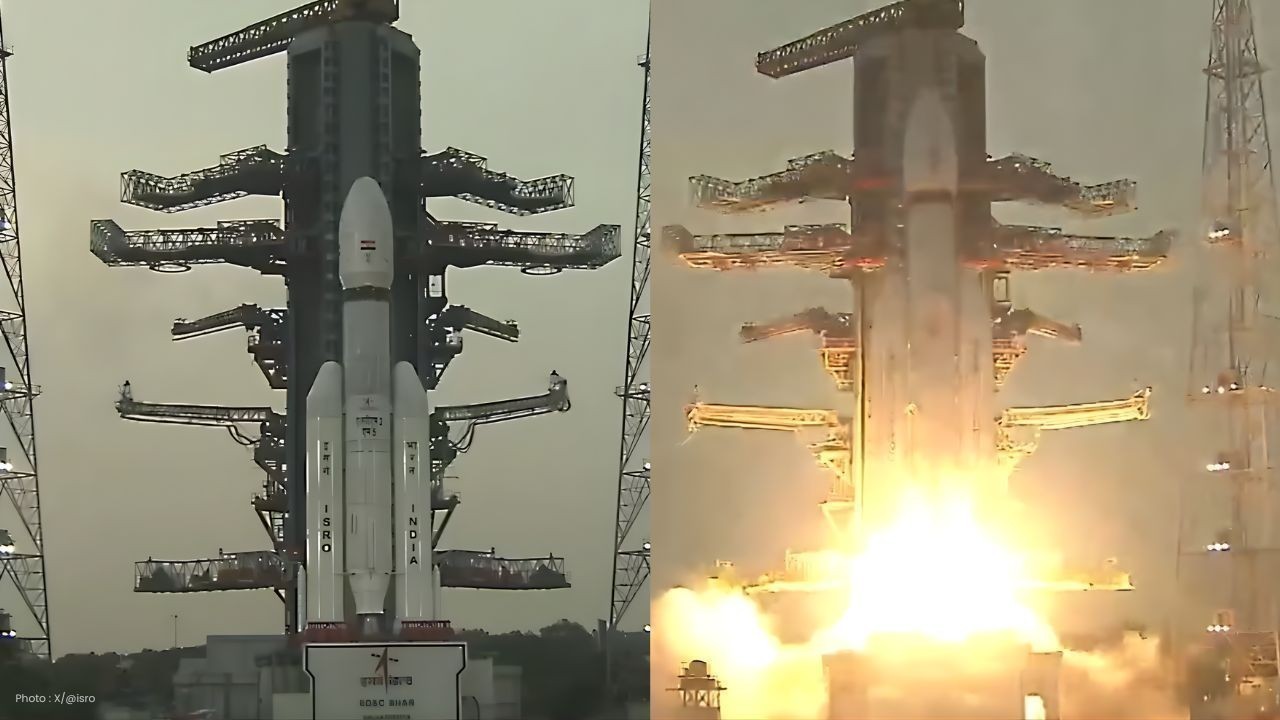
In a landmark achievement for India’s space program, the Indian Space Research Organisation (ISRO) on Sunday successfully launched the country’s heaviest communication satellite, CMS-03, from Sriharikota, Andhra Pradesh. The satellite, weighing a massive 4,400 kg, was carried into orbit by ISRO’s homegrown heavy-lift LVM3-M5 rocket, affectionately dubbed ‘Bahubali’.
The launch, which took place at 5:26 pm from the second launch pad of the Satish Dhawan Space Centre, marks a significant milestone in India’s journey toward self-reliance in space technology. CMS-03, developed entirely in India, is designed to provide multi-band communication services over a vast ocean area, including the entire Indian landmass, for at least 15 years.
Beyond enhancing general communication, CMS-03 is set to play a crucial role in strengthening India’s maritime capabilities. The Indian Navy will benefit from the satellite’s advanced encryption, high-capacity transponders, and wide frequency coverage, enabling secure communication and improved situational awareness across the Indian Ocean Region. Experts say the satellite could become a game changer for national security and network-based naval operations.
The LVM3-M5 rocket, which carried CMS-03, is a testament to India’s indigenous engineering. Built entirely with domestic technology, including the powerful C25 cryogenic stage, the rocket boasts a proven track record since its first development flight in 2014. Its success underlines ISRO’s capability to handle increasingly complex missions and heavier payloads, paving the way for future ambitions in both communication and defense applications.
Sunday’s launch not only reinforces India’s technological self-reliance but also sets the stage for enhanced connectivity, national security, and global competitiveness in space technology. With CMS-03 now in orbit, India continues to expand its presence among the world’s leading spacefaring nations.