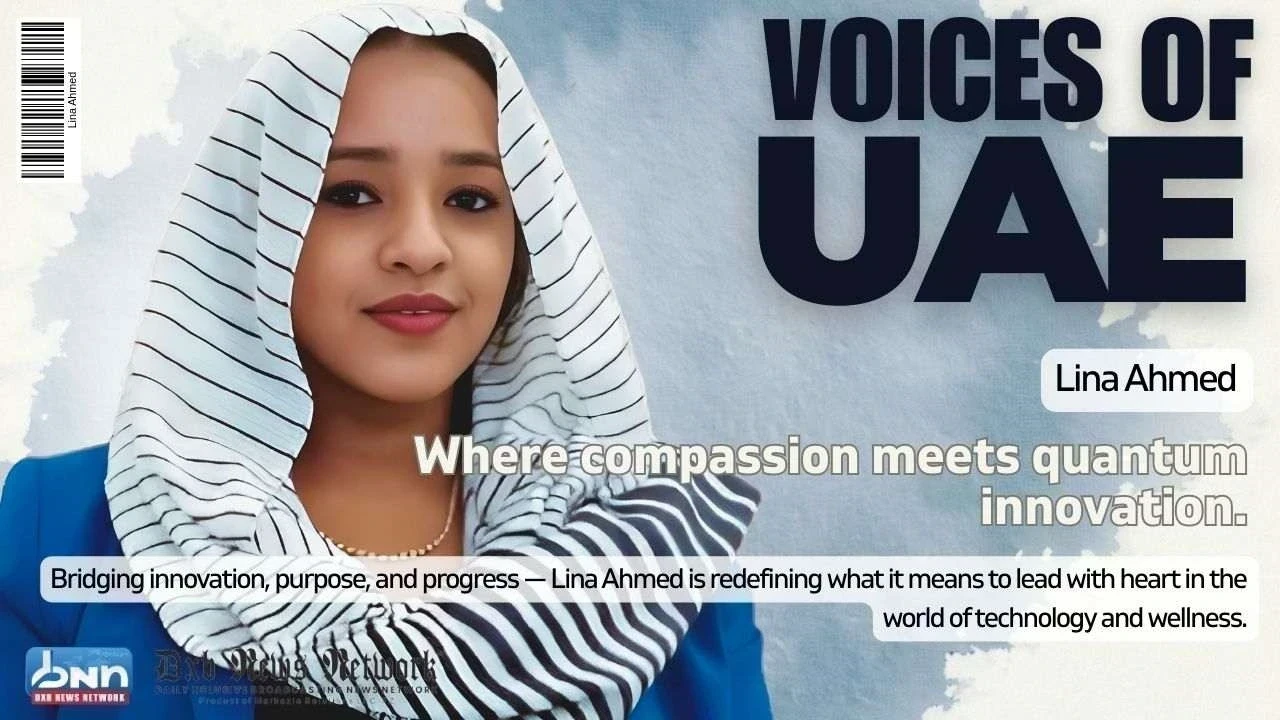
In the ever-evolving world of science and technology, few stories capture both brilliance and heart the way Lina Ahmed’s does. A biomedical engineer by training and a visionary by instinct, Lina has spent her life standing at the crossroads of purpose and progress — bridging healthcare, technology, and humanity through her work at QuantLase Research & Development Centre.
Her journey began not with ambition, but with empathy. The loss of her mother at a young age ignited a lifelong mission — to find ways through which technology could heal, protect, and empower. “I always felt that healthcare technology could improve lives,” she says. “That belief became my direction, my compass.”
Born in London and educated at Queen Mary University, Lina’s early academic years introduced her to the transformative power of science. It was there, in the halls of research and innovation, that she first encountered tissue engineering — a then-emerging field that opened her eyes to how science could truly reshape the human story.
Her career began humbly — as a sterilization technician, learning the importance of discipline, detail, and teamwork. “Every role matters,” Lina recalls. “From the engineer to the manager, every hand contributes to success.” These foundational years gave her the humility and precision that would later define her leadership style.
The turning point came during the COVID-19 pandemic. When the world paused, Lina chose to act. Joining QuantLase R&D Centre, she stepped into a world of urgent innovation. There, she became part of the pioneering team that developed the DPI device — a revolutionary diagnostic tool that tested over 7 million people and generated more than 1 billion dirhams in support of the UAE’s national COVID-19 response.
“It was more than a project,” she says. “It was a mission — to protect people, to restore hope, to help the nation heal.”
As the first woman among scientists and engineers at QuantLase, Lina carried not just her expertise, but a responsibility — to prove that women could stand shoulder-to-shoulder in the highest echelons of innovation. “It felt empowering,” she admits, “but it also reminded me that representation comes with accountability — to open doors for others.”
Under the mentorship of Dr. Pramod and a management team that believes deeply in gender inclusivity, Lina helped pave the way for a new generation of women in science. Today, QuantLase proudly counts several female engineers, researchers, and project leads — a testament to the culture she helped nurture.
From quantum photonics and AI-driven chips to biomedical imaging and sustainable energy, Lina’s portfolio reads like a map of tomorrow’s science. Yet, her favorite project remains the Photonic Intelligence Processing Unit (PIPU) — a groundbreaking innovation capable of predicting market trends and complex patterns with over 90% accuracy. “It’s the kind of project that redefines what’s possible,” she says, “where physics meets foresight.”
Balancing innovation with empathy, Lina has always believed that technology must serve humanity — not the other way around. “True progress isn’t measured in numbers,” she reflects, “but in the lives we touch and the hope we create.”
Outside the lab, Lina’s work extends to mentorship, collaboration, and advocacy for women in STEM. She partners with brilliant minds like Dr. Fatma Abbass and Ms. Renuka Menon, fostering a spirit of sisterhood within the UAE’s growing community of women technologists. “We rise together,” she says. “There’s no competition, only collaboration.”
Her journey has not been without sacrifice. During the height of the pandemic, Lina worked tirelessly — often away from her young children — driven by the conviction that her work would create a safer future for them. “That was my hardest decision as a mother,” she confides, “but I knew the mission was bigger than me.”
When asked what she hopes young women take away from her story, her answer is simple yet profound:
“You don’t need to fit in to make a difference. Believe in your purpose, work hard, and let your light define its own space.”
For Lina Ahmed, innovation isn’t just about algorithms and data — it’s about empathy, courage, and the unwavering belief that science can heal the world.
And through her journey, one truth shines clear — the future of technology isn’t only quantum. It’s human.